
Searching for practical pain mitigation in beef cattle
New studies on the effectiveness of pain-mitigating options for beef cattle are helping Canada’s cattle industry take another step forward to revised regulations for animal welfare.
By Lucas HorsmanCastrating young male calves is essential to the operation of any beef cattle operation, yet Canada’s current Code of Practice for the Care and Handling of Beef Cattle doesn’t prescribe any particularly practical means of providing pain mitigation to the animals during this invasive procedure.
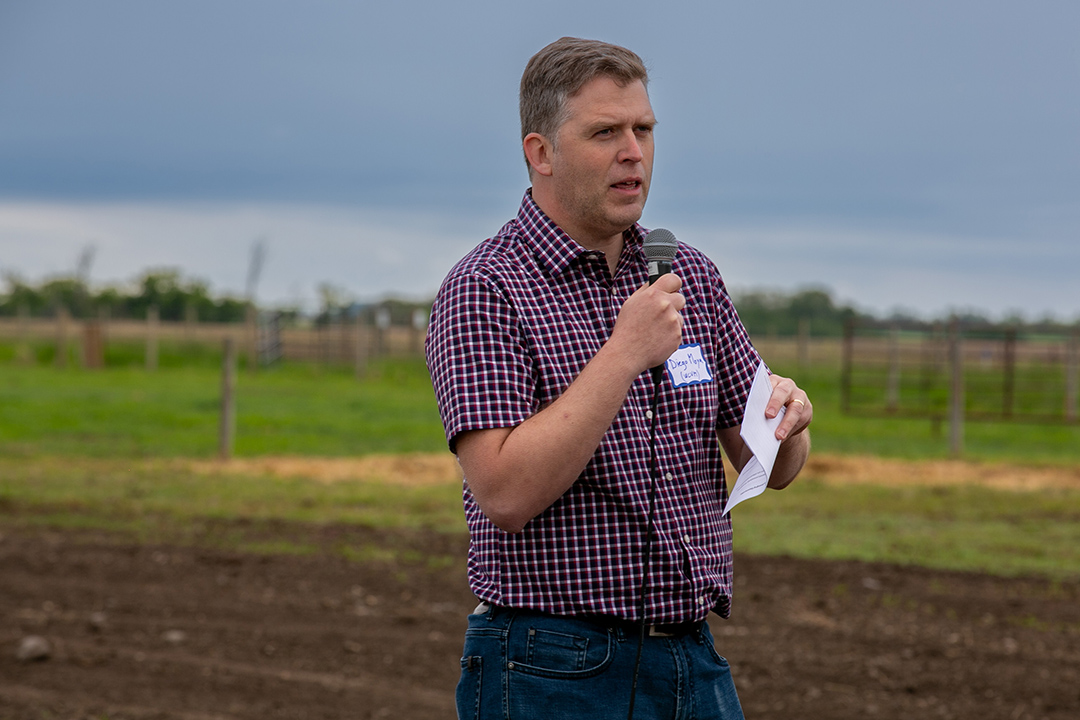
Despite this reality, the use of pain mitigation techniques among cattle producers is on the rise — a trend that Dr. Diego Moya (DVM, PhD) of the Western College of Veterinary Medicine (WCVM) is pleased to see.
“Before it was one of every 10 producers using any sort of pain mitigation,” said Moya, an associate professor of animal behaviour and welfare in the WCVM’s Department of Large Animal Clinical Sciences. “Now it's one of every four producers …. And again, that's with all the challenges that we are facing and not finding the optimal solution.”
Mitigating pain to the ‘best of our abilities’
Moya shared his team’s research findings about pain mitigation with cattle producers, researchers, students and industry representatives on June 16 during the 2026 Summer Field Day at the University of Saskatchewan (USask) Livestock and Forage Centre of Excellence (LFCE).
This annual event at the research and teaching centre allows scientists to share recent developments in agricultural science and veterinary medicine with producers as well as other members of the industry.
As Moya explained to his audience, “pain mitigation” refers to reducing the amount of pain that these animals experience through routine herd management procedures such as castration, dehorning and branding.
He and other members of his WCVM research team have examined different ways in which pain mitigation practices can be adopted without presenting major challenges that interfere with the business side of raising cattle.
Moya is a member of the scientific committee for the beef cattle code of practice, which is under revision through the National Farm Animal Care Council (NFACC). This governing body brings together diverse groups of stakeholders to develop and revise Canada’s codes of practice for the care and handling of all farm animals.
“We have to find the equilibrium between something that is practical, efficient and affordable for producers to be using in the long term,” Moya said. “The last component is [affordability]. It has to be cost-efficient. If it is efficient and practical but costs $1,000 per animal, no one is going to use it.”
Managing pain associated with castrations
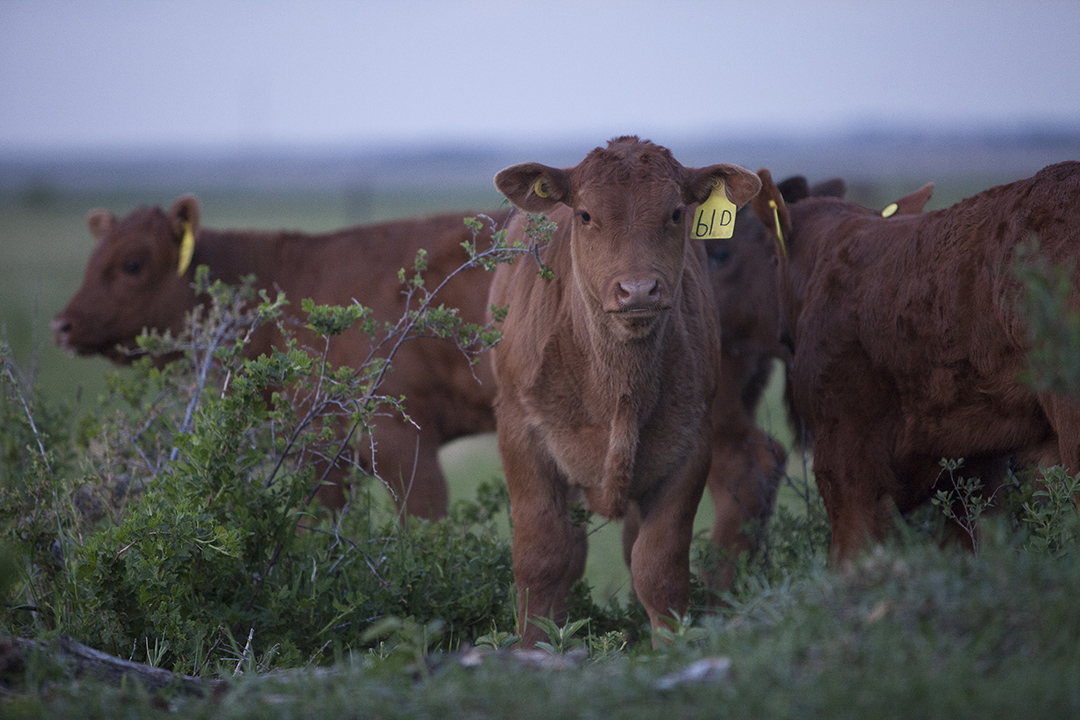
Traditionally, beef cattle producers have castrated their calves using one of two options: banding or knife/surgery. Banding involves using elastic bands to restrict blood flow to the testicles, so they eventually fall from the animal’s body, while the surgical route requires an incision and the use of handheld tools like an emasculator.
“Both of these options are painful and cause distress and discomfort to the animals,” Moya pointed out. “There is no one technique clearly better than the other one.”
The difference between the two methods lies in the amount of pain experienced over time. The discomfort caused by banding is less intense but lasts for weeks, whereas the surgical procedure causes more intense pain that lasts for a shorter period.
The only drug that’s specifically labelled to mitigate pain during castration is the oral form of meloxicam, a nonsteroidal anti-inflammatory drug (NSAID). But meloxicam can take hours to become effective once ingested — time that can’t be spared when producers may be working with hundreds of calves during a herd castration day.
Lidocaine, the same local anesthetic that dentists use to help reduce their patients’ pain during dental procedures, can be used during castration to numb the pain in the area. However, the painkilling drug can take up to five minutes after injection before becoming fully effective. It also takes some skill to properly inject lidocaine in animals.
“[A] complaint of lidocaine has always been that it takes from two to five minutes to have an effect on the animal,” said Moya. “You either have to wait with the animals there in the chute or [administer] the lidocaine, release the animal, and then bring them back again to the chute and do the procedure.”
There are a couple ways to overcome these obstacles, one being to combine the two drugs. Meloxicam provides pain mitigation to the entire body when administered, and lidocaine provides relief for the animal in the immediate area of the injection site. This approach ensures that the pain is reduced on all possible fronts, including immediate and long-term discomfort.
Moya's team tested this method by taking two groups of calves and giving meloxicam doses to all animals. The researchers then gave lidocaine to only one group of calves in addition to the meloxicam doses. Rather than waiting for the lidocaine to take its full effect, Moya’s team administered the lidocaine to the calves and then surgically castrated each animal after only waiting 90 seconds.
The study’s results seem to indicate that the combination makes a difference, even after a shorter wait period. Calves that received both meloxicam and lidocaine doses and were then castrated after a 90-second wait period displayed lower rates of pain behaviour such as foot stomping, tail flicking or abnormal movement compared to calves that had only received the meloxicam before castration.
These findings are good news for cattle producers, allowing them to provide their animals with some amount of pain mitigation without significantly slowing down the process of castrating their herd’s male calves.
While lidocaine can also be used during banding, the process is much different. Instead of injecting lidocaine, certain types of castration bands are coated with lidocaine (described as “lido-bands”) and provide pain relief through skin contact. This treatment could help to keep the animal comfortable in the long-term, as pain control drugs like lidocaine are typically only effective for a short time after injection.
Such products can help remove the need for delicate procedures in which lidocaine is injected into the animal, but there are a couple of downsides.
“The discomfort of the banding itself is not being mitigated at all. And then when the testicles are falling off, the band is falling with the testicles,” said Moya. “At the time when the wound is open and can cause some pain, the lidocaine might not be there as well.”
The research work done by Moya’s team and other international researchers has served as a valuable information source during the recent review of Canada’s beef cattle code of practice, which includes updated recommendations about pain mitigation for castration, branding and other activities.
Some of these updated recommendations are substantiated by results found in Moya’s previous studies.
His participation in research projects investigating the pain intensity of different castration techniques has led to changes in the revised code of practice — specifically that analgesic medications are effective in reducing the pain associated with surgical castration in male calves. As most available pain mitigation drugs are short-acting, they cannot cover the longer period of discomfort caused by banding.
Moya’s contributions on the effectiveness of NSAIDs such as meloxicam at providing pain mitigation also informed the code’s revisions. The updated code of practice now supports the use of NSAIDs alongside other pain mitigation solutions as the most effective approach to reducing pain.
By integrating the findings from research studies such as Moya’s work, the revised code of practice — due to be released in early 2027 — can provide cattle producers with additional, evidence-based options for mitigating pain in their animals.
Lucas Horsman of Indian Head, Sask., is a journalism student at the University of Regina. Horsman was the WCVM’s summer research communications intern in 2026.
Together, we will undertake the research the world needs. We invite you to join by supporting critical research at USask.